

Views: 0 Author: Site Editor Publish Time: 2026-11-21 Origin: Site
Manually moving a heavy trailer is a fast track to a spinal injury. Picture sweating under the summer sun, straining your lower back just to pivot a massive chassis. Or worse, trying to back it into a tight driveway with your truck while praying you do not scrape the siding of your house. It is frustrating. It is highly dangerous. Many owners look into motorized solutions to save their backs and prevent costly property damage. But one critical question always arises: Is this machine actually strong enough to handle my specific load safely?
Recently, the towing industry has seen a massive shift toward high-efficiency, battery-powered mobility. As more solo travelers and retirees hit the road, the demand for compact, high-torque movers has skyrocketed. Modern engineering now focuses on maximizing pulling power without adding unnecessary bulk. A high-quality motorized mover changes the game for solo parking. However, safe towing depends entirely on understanding weight limits, tongue pressure, and surface terrain. Operating heavy machinery requires strict adherence to mechanical specifications. This guide breaks down exactly what these units can handle. You will learn how to calculate your true load, evaluate your driveway, and pick the right equipment.
Weight Ranges Vary Significantly: Standard motorized dollies safely maneuver anywhere from 2,000 lbs up to 10,000 lbs. Heavy-duty commercial models handle even more extreme loads.
Tongue Weight is the Crucial Metric: Safe towing is not solely about the total mass. Your equipment must be structurally rated to handle the downward force of your trailer. This downward pressure is typically 10 to 15 percent of the total weight.
Terrain Dictates True Capacity: Environmental factors matter immensely. Inclines, loose gravel, and wet grass drastically reduce safe towing capacity compared to flat, dry concrete.
Specialized Designs for Specific Loads: Recreational vehicles and marine vessels have different physical profiles. They require different hitch configurations and traction capabilities due to varying weight distributions.
Safety Must Come First: Exceeding rated weight limits results in critical motor burnout, structural frame failure, or a dangerous loss of braking control.
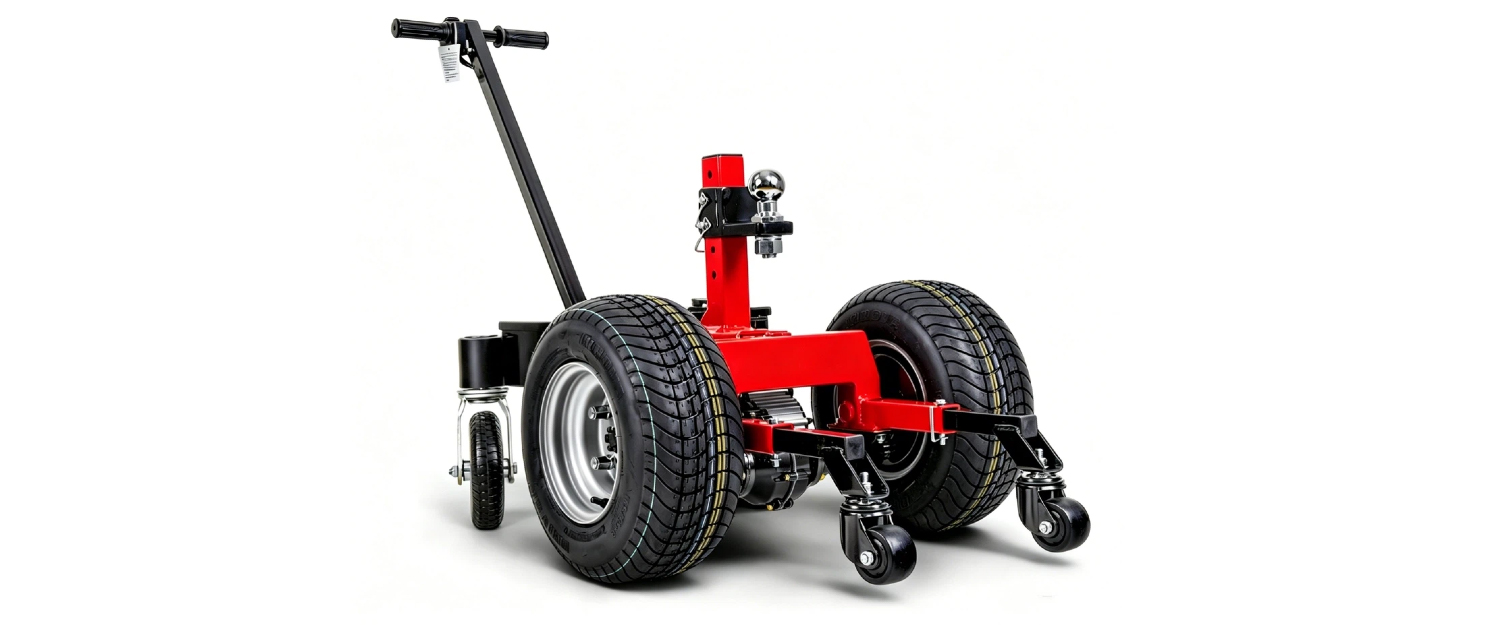
Before spending a dime on towing equipment, you must understand the two critical weight metrics. Manufacturers base safety ratings on these specific numbers. Getting this wrong is the leading cause of bent frames and burnt motors. You must distinguish between the overall mass being pulled and the specific downward pressure applied directly to the machine.
Gross Trailer Weight refers to the absolute total weight of the fully loaded trailer. This metric includes the bare chassis, the hull of a boat or the shell of a camper. It also includes all loaded cargo, full water tanks, propane cylinders, batteries, and aftermarket modifications. If a machine is rated for a 5,000 lb maximum limit, the total mass rolling on its own axles must never exceed this number.
Tongue Weight is the amount of downward pressure resting directly on the hitch ball. Trailers act like a lever over their axles. A portion of the total weight transfers to the front attachment point. Proper towing physics dictate that this downward force should be between 10 and 15 percent of the total gross weight to maintain stability.
It is entirely possible for a trailer to fall under the gross weight limit but dangerously exceed the tongue weight limit. Imagine a scenario where your equipment is rated for 5,000 lbs total mass and 500 lbs of downward force. If your 4,500 lb camper is heavily front-loaded and generates 650 lbs of downward pressure, the equipment is unsafe to use. Ignoring this metric bends structural steel frames. It compresses tires until they can no longer rotate.
Not all machines are engineered with the same structural materials, motor wattages, or gear ratios. Categorizing these units by their tested capacities helps identify which tier fits your specific needs. This prevents you from under-equipping or overspending for your driveway scenario. A reliable Powered Trailer Mover is built to match the exact physical demands of your load.
To make selection easier, refer to the engineering comparison table below. This breaks down the standard industry tiers, helping you match your load to the correct mechanical specifications.
Equipment Tier | Max Gross Weight | Max Tongue Weight | Motor System | Best Suited For |
|---|---|---|---|---|
Light-Duty | Up to 2,500 lbs | 250 lbs | 12V or 24V | Jet skis, ATVs, small utility trailers |
Medium-Duty | 2,500 to 5,000 lbs | 500 lbs | 24V High-Torque | Teardrop campers, dual-axle utility, mid-sized boats |
Heavy-Duty | 5,000 to 10,000+ lbs | 1,000+ lbs | 36V or 48V Transaxle | Large travel trailers, 5th wheels, commercial equipment |
Light-duty models utilize smaller 12V motors and lighter frame constructions. They are engineered for precision in tight spaces rather than raw brute power. These units perform best with small single-axle utility trailers, lightweight aluminum boat trailers, and compact pop-up campers. They require completely flat, paved surfaces. They will struggle significantly if introduced to grass or slight inclines.
The medium-duty category represents the most popular consumer segment. The 5,000 lb threshold is a standard benchmark covering the vast majority of recreational trailers. These units feature upgraded transaxles and aggressive tire treads. They handle average-sized fiberglass boats and mid-sized travel trailers with ease. You will often find integrated automatic braking systems and heavy-duty pneumatic tires in this tier. This allows for safer maneuvering on mild slopes.
When dealing with massive loads, a heavy-duty solution is non-negotiable. These machines utilize high-torque 36V or 48V motors and heavy-gauge steel frames. Advanced gear reduction technology moves extreme weights without overheating. For instance, industrial-grade models from Hi-Shen are structurally tested to handle up to 10,000 lbs of gross weight and 1,000 lbs of tongue weight. Operating in this tier requires robust, solid-state polyurethane tires to prevent compression under massive downward pressure.
While the core mechanical function remains the same, the shape and weight distribution of your load dictate performance. You must match the equipment to the specific physics of your chassis.
Travel trailers are notoriously front-heavy. Manufacturers intentionally design campers to house heavy components at the front of the A-frame. Dual propane tanks, deep-cycle battery banks, and front storage compartments create massive downward pressure. Because of this concentrated weight, an RV Trailer Dolly faces unique physical challenges. It must handle exceptionally high tongue weights. Furthermore, backing a camper into a narrow residential driveway requires precise, low-speed articulation and robust braking power to prevent swaying.
In contrast, boats present an entirely different set of physical dynamics. Marine vessels are often rear-heavy. Massive outboard motors and fuel tanks sit at the stern, far behind the axles. This results in a surprisingly light tongue weight. Low downward pressure reduces tire traction, causing the drive wheels to slip. A Boat Trailer Dolly also deals with much longer tongues designed to keep the towing vehicle out of the water. Moving a boat frequently involves wet, slippery concrete at boat ramps. Superior tire traction and weather-resistant motor housings are absolute necessities here.
Manufacturer ratings are calculated under ideal, controlled laboratory conditions. They test on flat, dry, and smooth concrete. In real-world scenarios, various environmental factors drastically reduce maximum safe towing capacity.
Gravity is the biggest adversary of any motorized mover. If a machine is rated to move 5,000 lbs on a flat grade, introducing even a 5 percent incline changes the physics entirely. Pushing a heavy load uphill requires exponentially more torque. Holding a load downhill requires immense braking power. Attempting to push a maximum-capacity load up a steep driveway stalls the motor or causes tires to lose traction. Always consult the specific incline rating chart before attempting slope maneuvers.
Traction is just as vital as motor wattage. Raw power is useless if the tires cannot grip the ground. Smooth concrete and asphalt provide maximum traction. Loose surfaces like gravel and dirt cause tires to spin. Energy is wasted displacing rocks rather than moving the chassis. Wet grass is the ultimate challenge. It acts as a lubricant and severely compromises grip. Even with aggressive all-terrain tires, moving heavy loads on wet grass remains unpredictable.
Sustained torque under heavy loads relies heavily on the electrical system. A smaller system might provide enough initial burst energy to get a load rolling. However, a robust 36V or 48V system sustains movement over uneven terrain without drawing excessive amperage. Higher wattage motors run cooler and more efficiently under maximum strain. This prevents internal safety relays from tripping during a difficult parking maneuver.
Ignoring weight limits is not just a matter of voiding a warranty. It presents immediate physical dangers to the operator and the surrounding property.
When an electric motor is forced to push a load heavier than its design parameters, it draws excessive electrical current. It desperately attempts to generate more torque. This massive spike in current generates extreme heat inside the copper coil windings. If pushed too long, wire insulation melts. The result is catastrophic motor burnout. The immense pressure can also strip teeth off internal steel gears or bend the primary drive shaft.
The most severe danger is the loss of stopping power. High-quality units feature automatic dynamic braking. When you release the throttle, the motor locks to stop the wheels. However, if the momentum exceeds the friction limit of the tires, the chassis will continue to roll. On a decline, an overloaded camper can drag the machine and the operator down the hill. This leads to severe injuries and property destruction.
Guessing your weight leads to purchasing underpowered, unsafe equipment. You must accurately determine the true mass before investing in a motorized solution.
Start by locating the VIN sticker on the front left side of the frame. Look for the Unloaded Vehicle Weight. This is the dry weight as it rolled off the assembly line, completely empty. You should also note the Gross Vehicle Weight Rating. This is the absolute maximum weight the axles and frame are legally certified to carry.
Dry weight is highly deceptive. You never move an empty camper. You must calculate your true loaded weight. Add the weight of fresh, gray, and black water tanks. Water weighs roughly 8.3 lbs per gallon. A full 40-gallon tank adds over 330 lbs instantly. Factor in full propane tanks, heavy deep-cycle batteries, tools, and aftermarket modifications.
Once you know the total loaded mass, verify the downward pressure. For smaller utility loads under 300 lbs, you can use a sturdy piece of wood on a standard bathroom scale to distribute the load. For heavier travel trailers, this is extremely unsafe. Invest in a specialized tongue weight scale. Alternatively, take your fully loaded setup to a commercial scale to get highly accurate axle measurements.
Selecting the correct equipment requires matching your calculated numbers and environmental conditions to the right machine. Follow these engineering guidelines to ensure a safe purchase.
Never buy a unit where your weight exactly matches the maximum limit. Engineers highly recommend the 20 percent buffer rule. If your fully loaded setup weighs 4,000 lbs, look for a machine rated for at least 4,800 to 5,000 lbs. This buffer ensures the motor will not overheat during prolonged use. It provides the extra torque necessary to overcome small bumps, expansion joints, or slight inclines.
A motorized mover is useless if it cannot securely attach to your coupler. Ensure the unit offers the exact ball size required. Some heavy-duty setups utilize pintle hitches or require specialized frame-mount brackets. Verify that the manufacturer provides the specific mounting hardware necessary for a secure, zero-play connection.
When safety and property are on the line, sourcing equipment from reputable manufacturers with proven engineering standards is vital. Look for companies that transparently list structural load limits, motor specifications, and terrain capabilities. Researching the background of a trusted manufacturer like Hi-Shen provides peace of mind. You ensure you are investing in reliable, industrial-grade equipment capable of protecting your heavy assets.
A motorized trailer dolly is a powerful tool for safe and precise maneuvering. However, you must respect its gross weight and tongue weight limits. Whether you are parking a heavy camper in a narrow suburban driveway or navigating a wet marina with a dual-axle boat, assessing your total loaded mass and evaluating your surface terrain is key. Stop struggling with manual moving. Eliminate the risk of back injuries. If you are ready to bring ease of use and total control to your driveway, evaluate your specific towing needs and choose a heavy-duty solution engineered for the job. Visit Hi-Shen today to explore industrial-grade powered movers designed to handle your exact weight class safely and efficiently.
Yes, but inclines significantly reduce the maximum towing capacity. Gravity creates substantial resistance against the electric motor. A machine rated for 5,000 lbs on flat ground may only safely move 2,500 lbs on a slight grade. Always check the manufacturer incline rating before attempting slope maneuvers.
Yes, provided it is equipped with heavy-duty, all-terrain tires featuring deep treads. However, soft or loose surfaces fundamentally reduce traction. This loss of grip lowers the safe towing capacity compared to moving on smooth concrete. Operators should exercise extreme caution on wet grass.
Moving heavy loads on gravel requires specific engineering. Standard smooth tires will spin and dig into the stones. To succeed on gravel, you need a medium to heavy-duty unit equipped with aggressive pneumatic or solid-state all-terrain tires. You must also account for a 20 to 30 percent reduction in overall pulling capacity due to the loose surface friction.
Battery life depends entirely on the load weight, terrain, and motor voltage. A standard 24V or 36V system typically provides 30 to 45 minutes of continuous, heavy-load runtime on a single charge. Because most parking maneuvers take less than five minutes, a fully charged unit can easily perform multiple parking jobs over several weeks before needing a recharge.
High-quality units feature automatic braking systems designed for safety. If the power cuts out unexpectedly or you release the operational throttle, the internal gears automatically lock the wheels. This fail-safe mechanism prevents the chassis from rolling away, protecting both the operator and the property.
Visual and operational cues indicate excessive downward pressure. If the tires compress severely, the structural frame bows, or the drive wheels struggle to gain traction on flat ground, your downward force is likely too high. Always weigh your front attachment point before use to ensure it falls strictly within specified limits.
While the core motor technology remains the same, boat setups often feature longer tongues and different weight distributions. Because boats carry heavy outboard motors at the rear, front pressure varies drastically. Some models offer specialized hitch attachments or extended handles to better accommodate the unique dimensions of marine equipment.

